
Marketing Concepts Explained: The Complete 2026 Guide
- Geethapriya Venugopal

- May 4
- 10 min read
Most businesses don't fail because they have a bad product. They fail because they're using the wrong marketing concept for their business stage.
A startup burning budget on emotional brand campaigns. A D2C brand pushing hard sales tactics to first-time visitors. A funded company running production-style marketing in a crowded market. It's everywhere.
Understanding marketing concepts isn't just academic theory for your MBA exam. It's a business survival skill. The right concept drives growth. The wrong one wastes money.
In this guide, you'll learn all five core marketing concepts, what they mean, when to use them, and how real Indian brands like Jio, Zomato, Amul, and OnePlus have applied them to build dominance. You'll also get a decision framework so you know exactly which concept fits your business right now.
The simplest example to understand the marketing concepts:
🍽️ Think of it like a restaurant:
Just like a great dish needs both fresh ingredients and the right recipe, great business growth needs good marketing concepts and the right strategy.

You can have the best product in the market, but without a clear marketing strategy, it won't reach the people who need it most. Fresh ingredients alone don't make a meal. A recipe alone doesn't feed anyone. It's when both come together that something truly satisfying is served.
The same logic applies to business growth. Good marketing concepts, understanding your audience, crafting your message, and choosing the right channels are your ingredients. Your strategy is the recipe that brings it all to life. Together, they create growth that's not just quick, but sustainable.

So before you ask "why isn't this working?", check your kitchen first. Do you have the right ingredients? And are you following the right recipe?
What Are Marketing Concepts?
Marketing concepts are the foundational philosophies that guide how a business thinks about its customers, its product, and its growth strategy.
They answer one central question: How should a business approach the market to create value and generate sustainable revenue?
These aren't just textbook definitions. They are real decision-making lenses that determine where you invest, what you say, and how you sell. Philip Kotler, the godfather of modern marketing, defined five core marketing concepts that every business consciously or unconsciously operates from.
Knowing which one you're using, and whether it's the right one, changes everything.
The 5 Core Marketing Concepts: At a Glance
Before we break each one down, here is a quick reference table. Keep this open as you read.
Concept | Focus | India Example | Best Stage | Risk |
Production | Scale & Cost | Jio | Market Entry | Ignores quality |
Product | Features & Quality | OnePlus | Innovation Stage | Better mousetrap. |
Selling | Persuasion | LIC | Short-term push | Low retention |
Marketing | Customer Needs | Zomato | Growth Stage | Needs research |
Societal | Society + Profit | Amul / Tata | Brand Maturity | Higher cost |
1. The Production Concept
Production Concept Make it cheap. Make it everywhere. India Example: Reliance Jio, launched in 2016 with free SIM cards, free data, and near-zero call rates. Their bet was simple: if it is affordable and widely available, India will adopt it. And India did, 450+ million subscribers. Best used when: You are entering a price-sensitive market, demand exceeds supply, or your primary advantage is scale and distribution. |
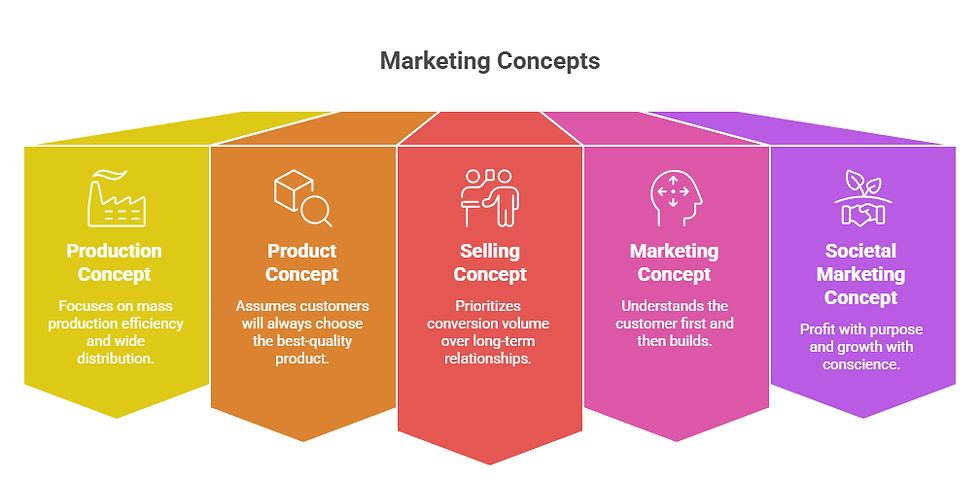
The production concept is the oldest marketing philosophy. It operates on a simple belief: consumers prefer products that are widely available and low-cost. Businesses using this concept focus on mass production efficiency and wide distribution.
This worked brilliantly in post-independence India when supply was scarce, and getting a product to someone's doorstep was the challenge. It still works today in high-volume, low-margin categories like FMCG, telecom, and commodity goods.
Where It Breaks Down
When competition increases, and products start looking the same, price alone stops winning. Brands that only compete on production efficiency get commoditised. You become invisible on a crowded shelf.
The trap: You can produce a million units, but if nobody wants your specific version, you're left with inventory and zero loyalty.
When to Apply It in 2026
You are launching into a new market where awareness is low
You are competing in FMCG, generic SaaS, or commodity services
Your distribution is your biggest competitive edge
You are scaling a product that already has proven demand
2. The Product Concept
Product Concept Build the best product and they will come. India Example: OnePlus India entered the market with flagship-level specs at mid-range prices. Their entire marketing was product-led: faster processor, better display, and superior camera. The product was the message. Best used when: You are competing in a quality-conscious segment where features drive purchase decisions, and your product is genuinely differentiated. |
The product concept assumes that customers will always choose the best-quality product. Businesses operating here invest heavily in R&D, continuous improvement, and feature development.
In India, this plays out strongly in smartphones, EdTech, SaaS tools, and premium D2C brands. Customers in these segments research deeply before buying and genuinely compare specs and reviews.
The Better Mousetrap Fallacy
Here is the risk: companies obsessed with the product concept assume that a superior product markets itself. It doesn't. Apple does not just build the best phone. Apple tells you why the best phone matters to your life.
This is called the better mousetrap fallacy, the belief that quality alone creates demand. Without positioning, distribution, and clear communication, even great products stay invisible.
You can use Brezzelo to run content experiments that tell your product story clearly, ensuring your quality actually converts into awareness and leads.
When to Apply It in 2026
Your product has genuine, measurable advantages over competitors
Your audience is research-driven and comparison-focused
You are in premium D2C, SaaS, EdTech, or health tech
You can back your product claims with data, reviews, and proof
3. The Selling Concept
Selling Concept Push harder. Close faster. India Example: LIC (Life Insurance Corporation of India), for decades, LIC agents used face-to-face persuasion, urgency-driven conversations, and relationship-based selling to push insurance products. Most customers did not wake up wanting insurance; they were sold it. Best used: when you have a product with low organic demand, a short sales cycle need, or a time-sensitive offer to convert. |
The selling concept operates on the idea that customers will not buy enough unless you aggressively push, promote, and persuade. It prioritizes conversion volume over long-term relationships.
This is not inherently bad. In India, it still works well for insurance, real estate brokerages, certain B2B services, and seasonal e-commerce sales (Diwali, Big Billion Day). The festive sale banners, countdown timers, and flash discounts you see on Flipkart and Myntra? Pure selling concept.
Where the Selling Concept Fails
It creates one-time buyers, not loyal customers. If you mislead or over-persuade, the customer will not return. In the age of Google reviews and Twitter callouts, the damage is permanent.
The selling concept can fill your pipeline quickly. But it will drain your retention metrics just as fast.
When to Apply It in 2026
You need a short-term revenue push, launches, clearance, seasonal campaigns
Your product has a long adoption curve and needs active education + persuasion
You are in high-touch B2B sales with a dedicated SDR or sales team
Use sparingly for BOFU content; never build your entire brand on push tactics
4. The Marketing Concept
Marketing Concept Understand your customer better than anyone else. Then build for them. India Example: Zomato did not build a food delivery app and push it aggressively. They obsessed over the Indian food lover: late-night cravings, weekend indulgences, mood-based food decisions. Their product, communication, and campaigns are all built around one thing: What does the customer feel right now? Best used when: You are in a competitive market, have PMF, and need to build retention, loyalty, and word-of-mouth growth. |
The marketing concept is the philosophy that drives most modern growth-stage businesses. It flips the traditional model: instead of building and then selling, you understand the customer first and then build.
The 5 Pillars of the Marketing Concept
Identify: Who is your target market?
Understand: What do they need, want, and feel?
Develop: Build solutions that address those exact needs
Differentiate: Satisfy needs better than competitors
Profit: Do all of the above sustainably
Execution Workflow: Applying the Marketing Concept
Run a customer discovery session, 10 interviews minimum. Document real phrases, real frustrations, and real goals.
Build a customer insight map: demographics, psychographics, trigger events, and objections.
Map your product features to customer needs, not specs, but outcomes (faster checkout, less food waste, and more time saved).
Build your content and campaigns around those outcomes, not your product.
Measure retention and NPS, not just acquisition. If customers don't stay, your marketing concept execution is broken.
5. The Societal Marketing Concept
Societal Marketing Concept Profit with purpose. Growth with conscience. India Example: Amul, India's original societal marketer. Every Amul campaign is rooted in cultural truth, social commentary, and real India. Amul does not just sell butter. They reflect India to itself. Best used when: Your brand has matured, you have a loyal customer base, and you want to build long-term trust, brand equity, and cultural relevance. |
The societal marketing concept adds a third dimension to the marketing concept. It says, "Satisfy your customers' needs and society's long-term wellbeing, all while being profitable."
This is not just ESG compliance or a CSR press release. It is a genuine operating philosophy. In 2025, Indian consumers, especially Gen Z and millennials, are actively choosing brands that stand for something real.
Why It Matters More in India Right Now
India has 500M+ Gen Z and millennial consumers who research brand values
D2C brands with sustainability messaging see 22% higher LTV on average
Regional, local, and vernacular brands built on community values are outpacing generic national campaigns
Purpose-driven brands rank higher on trust scores in Indian consumer surveys
How to Apply It Without Being Fake
The biggest mistake brands make: slapping a cause onto their marketing without genuine alignment. Indian consumers see through performative purpose.
Authenticity check: Does your brand's actual behavior, hiring, sourcing, packaging, and pricing match your purpose claim? If yes, build your story around it. If no, fix the behaviour first.
Which Marketing Concept Should Your Business Use?
This is the question most marketing guides skip. Here is a practical decision framework based on your business stage and context.
Business Stage | Recommended Concept | Primary Goal | India Example |
Pre-launch / Startup | Production | Reach + Affordability | Jio (2016) |
Early Growth | Product + Marketing | Differentiation | OnePlus India |
Scale / Revenue push | Selling | Drive conversions fast | LIC campaigns |
Sustained Growth | Marketing Concept | Loyalty + Retention | Zomato / Swiggy |
Brand Maturity | Societal | Trust + Purpose | Amul / Tata |
One important note: most mature businesses layer multiple concepts simultaneously. Zomato runs marketing concept thinking in their product team, sells concept tactics in their festive promotions, and runs societal marketing in their sustainability campaigns. The goal is intentionality, knowing which concept you are using and why.
How Marketing Concepts Map to Your Funnel
Here is something you will not find in most marketing textbooks: every concept aligns naturally with a specific funnel stage. Get this alignment right, and your content-to-conversion rate goes up dramatically.
Funnel Stage | Marketing Concept Fit | Content Type |
TOFU (Awareness) | Production + Product | Blog, Reels, Explainer |
MOFU (Consideration) | Marketing Concept | Case studies, Comparisons |
BOFU (Conversion) | Selling + Societal | Demos, Reviews, Offers |
At TOFU (Top of Funnel), production and product concepts drive the narrative; reach, awareness, and education are the goals. At MOFU (Middle of Funnel), the marketing concept takes over — you need to show customers that you understand their specific problem better than anyone. At BOFU (Bottom of Funnel), the selling and societal concepts close the deal, with urgency, proof, and purpose.
Common Mistakes Marketers Make With These Concepts
Mistake 1: Using the selling concept everywhere. When every touchpoint feels like a push, customers disengage. The selling concept belongs at BOFU, not in your first Instagram post.
Mistake 2: Staying in the product concept bubble. Your engineering team will always love your features more than your customers do. Get out of the lab and into real customer conversations.
Mistake 3: Skipping the marketing concept and going straight to societal. Purpose-driven marketing without customer-centricity is just expensive PR.
Mistake 4: Mixing concepts without intention. Running a production-concept ad (focus: reach and price) next to a product-concept ad (focus: features) confuses your customer about what your brand actually stands for.
Mistake 5: Never evolving. Jio started with the production concept. In 2025, they are moving towards the marketing concept, personalized plans, JioTV, and targeted offers. Your concept must evolve as your business matures.
Tools to Implement Each Marketing Concept
Production Concept
Distribution & reach: Meta Ads, Google Ads (broad match), marketplace listings (Amazon, Flipkart)
Pricing intelligence: Pricing.ai, Google Shopping Insights
Product Concept
User feedback: Hotjar, Typeform, Intercom surveys
Feature analytics: Amplitude, Mixpanel
Review management: G2, Trustpilot, Google Reviews
Selling Concept
CRM + pipeline: HubSpot, Zoho CRM, Freshsales
Email sequences: Mailchimp, ActiveCampaign
WhatsApp sales automation: Interakt, Wati (popular in India)
Marketing Concept
Content + SEO: Ahrefs, SEMrush, Surfer SEO
Customer research: SparkToro, Google Trends India, AnswerThePublic
Funnel analytics: GA4, Clarity, Segment
Societal Marketing Concept
Brand storytelling: Canva, Adobe Express, Notion for brand guidelines
Community building: Discord, Telegram, WhatsApp communities
Impact tracking: Salesforce Sustainability Cloud, custom dashboards
Final Thoughts: Concepts Are Not Labels. They Are Decisions.
The five marketing concepts are not a checklist you complete once. They are a living framework that evolves with your business. The best marketers in India, the ones building brands that last, are the ones who know exactly which concept they are operating from at any given moment.
Jio used the production concept to democratize internet access. Zomato used the marketing concept to build emotional loyalty. Amul used the societal concept to become a cultural institution. None of them was picked randomly. They picked intentionally.
Now you can too.
Start with one concept. Apply it with clarity. Measure what moves. Then layer the next one as your business grows.
FAQ: Marketing Concepts for Business Growth
What are the 5 core marketing concepts?
The five core marketing concepts are the Production Concept, Product Concept, Selling Concept, Marketing Concept, and Societal Marketing Concept. Each represents a different philosophy on how a business should approach its market, customers, and growth strategy.
Which marketing concept is best for a startup in India?
For early-stage startups, the Production Concept works best — focus on reach, affordability, and distribution. As you gain traction, layer in the Product and Marketing concepts to differentiate and build retention.
Can a business use more than one marketing concept at a time?
Yes, and most mature businesses do. Zomato, for example, uses the Marketing Concept in product decisions, the Selling Concept during festive promotions, and Societal Marketing in sustainability campaigns. The key is knowing which concept you're using and why.
What is the difference between the Selling Concept and the Marketing Concept?
The Selling Concept starts with the product and pushes it aggressively to drive conversions. The Marketing Concept starts with the customer — understanding their needs first, then building solutions around them. One creates one-time buyers; the other builds loyal customers.
What is the better mousetrap fallacy in marketing?
It's the mistaken belief that a superior product will market itself. Just because your product is the best doesn't mean customers will find it or choose it. You still need clear positioning, distribution, and communication — quality alone doesn't create demand.


Comments